
DIY Software Regulatory Kit
Required. Affordable. Easy to use.
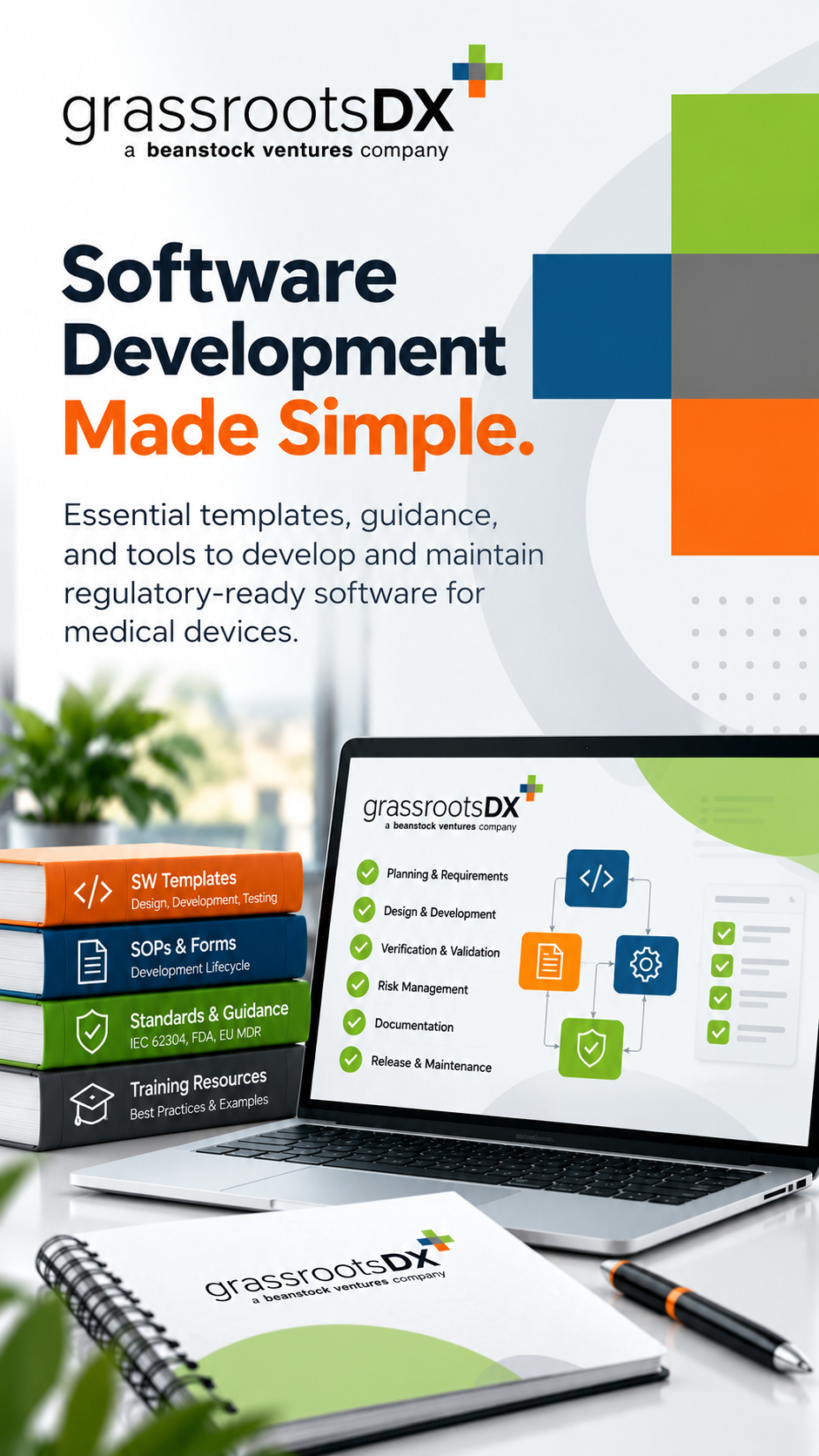
FDA Software Validation Guidance and Regulatory Kit
At Grassroots Dx, we provide a DIY Software Regulatory Kit with templates, training, and support for both SaMD and SiMD software teams developing medical device software. Our kit provides a structured framework for implementing software development lifecycle processes with the depth, rigor, and traceability needed to support regulatory submission.
Instead of requiring medical device software teams to build a software development and regulatory framework from scratch, we provide robust, IEC 62304 aligned templates designed to help software teams plan, design, develop, mitigate risks, test, and maintain medical device software by establishing detailed requirements and maintaining traceability throughout the software development lifecycle.
For software driven medical devices, software and cybersecurity can represent a significant portion of the technical evidence needed to support regulatory review.
Building that evidence as the medical device software is developed can help software teams prepare the supporting artifacts needed for FDA eSTAR submissions as well as applicable European and international regulatory requirements.
Save over $200k and 18 months in FDA preparation.
What's included in our DIY Software Regulatory Kit?
SOAR® Training
Monthly Q&A Sessions
Full DHF Templates
Peace of Mind
What Does FDA Software Validation Involve?
For medical device software teams, this can involve planning, detailed requirements definition, software architecture and design, risk management, development, verification and validation, defect and change management, regression testing, traceability, release, and maintenance. These activities should be integrated throughout the software development lifecycle to produce safe and effective medical device software, rather than performed primarily as a documentation exercise at the end.
Through our DIY Software Regulatory Kit, we provide structured design history file (DHF) templates and training designed to help medical device software teams implement these lifecycle activities in alignment with FDA software validation expectations, applicable FDA guidance for medical device software, and IEC 62304, Medical device software: software life cycle processes. The software framework helps engineering and regulatory teams implement the development activities needed to produce well defined, thoroughly tested medical device software while generating the evidence and supporting artifacts needed for regulatory submission.
Build a More Structured Verification and Validation Process
We provide software verification and validation templates that give teams a practical starting point for planning and implementing these activities. The framework helps software teams establish user and detailed requirements and acceptance criteria, define appropriate test methods, document test results and defects, manage software changes and regression testing, and maintain traceability from requirements and risks through verification and validation evidence.
The rigor of the verification and validation depends heavily on the rigor of the requirements. High level or incomplete software requirements can result in superficial testing that does not adequately challenge the medical device software or demonstrate that it performs as intended. Our framework is designed to help software teams develop the level of technical detail needed to support meaningful verification and validation throughout the software development lifecycle.
Our design history file (DHF) templates and training provide a structured approach that software engineering, quality, and regulatory teams can use to implement software verification and validation in alignment with FDA software validation expectations and IEC 62304, Medical device software: software life cycle processes. This helps software teams perform the expected development activities and generate the evidence needed to demonstrate the actual development and testing performed, maintain traceability, and prepare supporting artifacts for FDA eSTAR and regulatory review.
Organize Your Software Design History File
At Grassroots Dx, we include 24 full software design history templates in our Software Regulatory Kit. These SaMD and SiMD design history file templates provide a structured framework for software teams to plan, design, develop, mitigate risks, test, and maintain medical device software while maintaining traceability throughout the software development lifecycle.
Our templates provide a structured starting point for generating the technical documentation and artifacts needed to support FDA eSTAR and regulatory submission preparation, with traceability to IEC 62304, Medical device software: software life cycle processes, and alignment with applicable FDA software documentation expectations.
Key Standards & Guidance
- 21 Code of Federal Regulations – Part 11 Electronic Records; Electronic Signatures
- 21 Code of Federal Regulations – Part 820 Quality System Regulation for Medical Devices and In Vitro Diagnostic Products
- AAMI TIR45:2012 - Guidance on the Use of AGILE Practices in the Development of Medical Device Software
- AAMI/ISO 80002-2:2017 - Medical device software— Part 2: Validation of software for medical device quality systems
- AAMI/ISO TIR24971:2020 - Medical devices — Guidance on the application of ISO 14971
- ANSI/AAMI HE75:2009 (R2018) Human Factors Engineering - Design Of Medical Devices
- FDA Content of Premarket Submissions for Software Contained in Medical Devices
- FDA Design Controls Guidance for Medical Device Manufacturers
- FDA General Principles of Software Validation
- FDA Guidance Applying Human Factors and Usability Engineering to Medical Devices
- FDA Off-The-Shelf Software Use in Medical Devices
- IEC 60601-1 Medical electrical equipment
- IEC 62304 – Medical Device Software – Software Life Cycle Processes
- IEC 62366-1:2015 Medical Devices - Part 1: Application Of Usability Engineering To Medical Devices
- IEC 82304 – Health Software - Part 1: General requirements for product safety
- IEC/TR 80002-1:2009 - Medical device software – Part 1: Guidance on the application of ISO 14971 to medical device software
- IEC/TR 80002-3:2014 - Medical device software -- Part 3: Process reference model of medical device software life cycle processes (IEC 62304)
- IEEE 610.12-1990 - IEEE Standard Glossary of Software Engineering Terminology
- ISO 9001:2015 Quality management systems — Requirements
- ISO 13485:2016 Medical Devices – Quality Management Systems
- ISO 14971:2019 - Medical devices – Application of risk management to medical devices
- ISO/IEC/IEEE 29148-2018 - Systems and software engineering -- Life cycle processes -- Requirements engineering
- REGULATION (EU) 2017/745 – Medical Device Regulation
- REGULATION (EU) 2017/746 – In Vitro Diagnostic Regulation
Turn Regulatory Guidance Into Practical Software Development
Along with our templates, we include a 12 month subscription with access to 16 on-demand training modules, approximately 90 minutes each, totaling 24 hours of comprehensive software medical device regulatory training. We also provide one live expert Q&A session where participants can discuss software regulatory and quality topics with an industry expert.
Together, these resources provide software teams with templates, training, and expert support to help them implement robust medical device software development processes, prepare FDA software validation documentation, and navigate regulatory preparation.
Our resources address relevant guidance, regulations, and standards, including FDA software guidance, design controls, IEC 62304, ISO 14971, ISO 13485, human factors principles, and requirements engineering considerations. This provides software teams with resources to address medical device software development and supporting documentation across the broader software development lifecycle, rather than treating validation as a separate activity.
Create a Repeatable Path Toward Submission Readiness
A structured approach gives software teams a framework for addressing software development lifecycle requirements and generating supporting regulatory artifacts throughout development and submission preparation.
We combine comprehensive, highly technical, reusable templates, on-demand education, and expert support to help software teams establish that framework. Whether you are developing Software as a Medical Device (SaMD) or software contained in a medical device (SiMD), our DIY Software Regulatory Kit provides templates, training, and support for developing medical device software and generating the supporting artifacts needed for regulatory submission.
Contact us today to explore the DIY Software Regulatory Kit and build regulatory requirements into your software development process from the start.
Frequently asked questions
What is software validation for a medical device?
Software validation establishes documented evidence that software specifications conform to user needs and intended uses. FDA guidance for software validation provides principles that help manufacturers develop and maintain medical device software using appropriate software development lifecycle activities and generate evidence that the software performs as intended.
What are verification and validation templates used for?
What documentation belongs in a Software Design History File (DHF)?
A software design history file (DHF) can include records related to design planning, requirements, architecture and design, risk management, verification, validation, and design changes. This documentation provides evidence of the activities performed throughout the software development lifecycle. The applicable documentation depends on the medical device software and applicable regulatory requirements.
How can SaMD teams organize their DHF documentation?
SaMD design history file templates can provide a consistent framework for planning, designing, developing, mitigating risks, testing, and maintaining medical device software while establishing traceability from requirements and risks through design, testing, changes, and supporting evidence. The same framework can support SiMD teams developing software contained within a medical device.
Does the kit include training as well as templates?
Yes. The DIY Software Regulatory Kit includes a 12 month SOAR® Training subscription with 16 on-demand modules, approximately 90 minutes each, totaling 24 hours of training, along with one live expert Q&A session.
What FDA software validation documentation should teams prepare?
FDA software validation documentation can include plans, requirements, test protocols, test results, defect reports, traceability information, and other supporting evidence demonstrating that appropriate software lifecycle activities were performed. The documentation should reflect the actual software development, verification, validation, risk management, and change activities performed, not simply be created for submission.
Which standards and guidance does the kit address?
Is the Software Regulatory Kit designed for both SaMD and SiMD?
Yes. The kit is designed for medical device software teams developing both Software as a Medical Device (SaMD) and Software in a Medical Device (SiMD). It provides a structured framework for planning, designing, developing, mitigating risks, testing, and maintaining medical device software throughout the software development lifecycle while maintaining traceability and generating the supporting evidence and artifacts needed for regulatory submission.